Tuesday, March 15, 2011

"Call to Worship"

by Laura Ferris

God did a good job when he made you.

He looked upon you and said, "good, I'm glad you could make it. I missed you." You went away, you see, because you were ashamed.

You were ashamed of the way you twitch your nose when you sneeze, but God missed that.

You were ashamed of the way you love the things you don't understand, even though you claim to, and God missed that too.

You were ashamed of the everyday you, and God missed that most of all.

God missed you so much he came to find you again. He came to your house, where you live, and you thought him strange, even scary. Who is this crazy man outside my house? you wanted to know.

That's a good question. As far as I know, that man was the Living God, and something completely unexpected and impossible happened two thousand years ago. He died and rose from the dead, the story goes. He died and rose from the dead, and that saves you. He died and rose from the dead, and that frees you.

Because when God looks at you, he doesn't see what you see. He doesn't see failure or something broken. He sees the living, breathing you he had in mind. He sees the Living God, who stands in your stead, who takes your place, and who was there all along.

God did a good job when he made you.

Come and meet him where he is, with you, Emanuel.

Amen.


Big Waves

On Sunday, as we celebrated the grace of God and praised God for His goodness, people in North-Eastern Japan were recovering from a natural disaster of truly awful proportions. How do we reconcile a God of grace with natural disasters that beggar the imagination with their loss of life and human grief?

It’s a paradox that causes all of us to wonder at the God we claim to worship. In a recent slate article, Heather MacDonald finds the paradox intolerable.

"God knows that he can sit passively by while human life is wantonly mowed down, and the next day, churches, synagogues, and mosques will be filled with believers thanking him for allowing the survivors to survive. The faithful will ask him to heal the wounded, while ignoring his failure to prevent the disaster in the first place.”

I have to admit, my first thought in response to this was, well, what were any of us doing the next day? Is obsessively watching CNN any less of a paradox? Is ignoring it any less of a paradox? But I take her point; more than that, I feel it. If God is the one whom we praise and worship for his goodness, what are we to make of this disaster?

It was put more thoughtfully by a friend of mine in a text: “Paradox: How do I begin to reconcile the beauty of the waves on Ocean Beach and the immensity of the tragedy in Japan? Is that a question G-d finds impertinent?”

It’s no use simply to say that this is senseless. Everyone will and is trying to make sense out of what seems senseless. Humans will try to make sense of these circumstances. For the people in Japan, they must make some sense of it, or fall into despair. The question is, how will we make sense of it.

In Japan, I have heard two responses repeated. The first is the humanist response which makes sense of the situation through human effort. One young man said that the Japanese people would rise to the occasion and rebuild, because ‘that’s what humans do.’ This is a noble and brave sentiment which I personally respect. However, it doesn’t give meaning to anyone who has nothing to rebuild. It places the individual hope below the hope of ‘humanity-in-general’. Don’t get me wrong, I love humanity in general. But I would be lying if I didn’t say I have hope for myself, and so did the many who died this last week. But this is the secular gospel – make a way for yourself and don’t worry if you fall. There are others who will make a way for themselves. This secular gospel may give meaning and hope to the human race, but not to the individuals who are lost. Andy Crouch has written a very good article on this secular good news on his website.

The second is a more spiritual response (and by spiritual, I don’t mean better.) The most striking and controversial comment in Japan was from the governor of Tokyo, Shintaro Ishihara. He is a Shintoist and in a surprising admission for a public official, declared the tsunami ‘divine judgment’. In a recent statement he said; The identity of the Japanese people is selfishness. The Japanese people must take advantage of this tsunami as means of washing away their selfish greed. I really do think this is divine punishment.(And we thought America had a monopoly on insensitive spiritual leaders!)

Spiritually assigning blame is easy to do if you have the breathtaking boldness to speak for God. People are bad (or not as good as they should be) – and judgment comes. The gruesome curiosity in all this is figuring out exactly why these people got it so bad. Selfishness, homosexuality, devil-worship have all been recent reasons given… many think this is view of the Bible.

The Bible has NO patience for apportioning judgment on victims of disasters, illness or other crises. In fact, when people try to interpret disasters as a specific judgment on a person or people, they are usually proven horribly wrong. The best example in the New Testament is in Luke 13:4, where Jesus assesses a recent building collapse that killed 18 people. People ask him whether this was God’s judgment. Jesus says that the people who died – but all of us should be aware of the closeness of death to all of us. We all walk on a razor edge.

Both the secular and the simplistic religious responses are, in my mind, deeply inadequate and ultimately offensive. So, how does the Bible make sense of these disasters. I have a couple of thoughts, and then a response.

  1. It is good and right to question God in these circumstances. Through Scripture we see men and women of God asking hard questions of God. We cannot easily accept or easily reject the experiences of this life. We must bring them to God with urgency. Rather than being impertinent, these questions lead us into a more intense relationship with God. Let us not pretend that the scenes of devastation in Japan fill us merely with theological offense. We grieve. We are angry. We are hurt. God accepts and s that. This may not be acceptable to some, but what is the alternative? To be offended? At what? If God is not good, if there is no good and only matter, on what basis are we offended? Yes, the paradox of faith is that our very capacity to hold God to justice means that we must have gotten the idea of justice from somewhere. God may or may not respond to us. He is God and we are not. But there is the invitation to beat upon His breast. It is better to be angry at God, than to dismiss Him.

  2. A disaster like this should wake us up to the fragility of human life, to the true nature of our existence. It should make us humble. It may seem harsh to say, but whether it be in a bed or in a storm, all humans will die. If our life doesn’t make sense in light of death, then it never makes sense. A disaster like this, especially in a society that is as technologically advanced and organized as our own, should expose our weakness. We do not ultimately control our destinies. When we try to control things like the atom, then we find that nuclear power is not as in control as we had hoped.

  3. Disasters like this are chaotic and cannot be applied as particular judgment. However, any instance of death and global brokenness is a clue – that things are not as they should be. We think this situation is horrific, but on what basis? Surely this is nature. But if nature is all there is, why then are we sad? Why then do we question the meaning of life? The groaning of the world is a clue to the deeper yearning we have for meaning. Surely humans are made for more than this random destruction? Surely I can expect more from existence than meaningless death. The Bible tells us that the world is a battleground of good and evil, chaos and order. God is steadfastly against the great enemy of death. Evil and destruction must be opposed, and are opposed by God.

  4. We live in a serious universe. Pain is real. Men and women are destroyed in an instant. Children die. Cities are washed away in the dark. Our view of life, then, must be serious as well. We must not treat evil as an illusion, God as a simpleton puppet-master or people as rungs on the ladder of some mythical human progress. As humans, we must face up to the seriousness of our existence.

In such a serious universe, I see only one hope. That God will save us, in a way that I don’t fully understand. And that this God teaches us to be kind, compassionate and helpful in the face of the battle which is our lives.

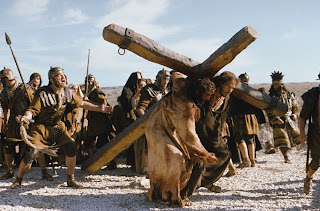
This is what the cross teaches me. That God will save us, even at death. And it teaches me that I can also make sacrifices for the sake of others, and that will mean something. The cross of Jesus may seem small in the face of the tsunami. For me, it is my only hope. I don’t know why God has allowed such great waves in our world. But His response is not to make the waves smaller. He promises to be a big God so that no wave, not even death will ultimately overwhelm us. The cross is how I make sense of it.

So, it comes down to faith. In a chaotic world in which humans are very small, very fragile and overwhelmed (in spite of our real bravery, cleverness and resilience), we must ask the hard questions about who or what we trust. Will we trust ourselves? Will we trust our technology? Will we trust nature? Or will we trust a God who has revealed himself in suffering, in death – and ultimately in resurrection.

I will admit, that there is no simple choice here. But when Jesus looks at a man whose daughter has just died and says ‘Do not fear, only believe’ I trust him. The cross and the resurrection of good Jesus honors the real suffering that this world lives amongst. The cross and the resurrection is the only trustworthy hope in a world that resists my control or understanding.

Finally, I highly recommend an author called David B. Hart. He wrote extensively in the wake of the 2004 tsunami, including a book called The Doors of the Sea. In a recent article he wrote the following, which I find to be exquisitely powerful in its beauty and truth:

"I do not believe we Christians are obliged -- or even allowed -- to look upon the devastation visited upon the coasts of the Indian Ocean [in the 2004 tsunami] and to console ourselves with vacuous cant about the mysterious course taken by God’s goodness in this world, or to assure others that some ultimate meaning or purpose resides in so much misery. Ours is, after all, a religion of salvation; our faith is in a God who has come to rescue His creation from the absurdity of sin and the emptiness of death, and so we are permitted to hate these things with a perfect hatred. For while Christ takes the suffering of his creatures up into his own, it is not because he or they had need of suffering, but because he would not abandon his creatures to the grave. And while we know that the victory over evil and death has been won, we know also that it is a victory yet to come, and that creation therefore, as Paul says, groans in expectation of the glory that will one day be revealed. Until then, the world remains a place of struggle between light and darkness, truth and falsehood, life and death; and, in such a world, our portion is charity.

“As for comfort, when we seek it, I can imagine none greater than the happy knowledge that when I see the death of a child I do not see the face of God, but the face of His enemy…. [We are set] free from optimism, and taught hope instead. We can rejoice that we are saved not through the immanent mechanisms of history and nature, but by grace; that God will not unite all of history’s many strands in one great synthesis, but will judge much of history false and damnable; that He will not simply reveal the sublime logic of fallen nature, but will strike off the fetters in which creation languishes; and that, rather than showing us how the tears of a small girl suffering in the dark were necessary for the building of the Kingdom, He will instead raise her up and wipe away all tears from her eyes -- and there shall be no more death, nor sorrow, nor crying, nor any more pain, for the former things will have passed away, and He that sits upon the throne will say, “Behold, I make all things new.”

Monday, February 21, 2011

Listen...

So, I am not very good at being a church planter. I have never done it before and there are so many hurdles to jump, potential mistakes and worst of all, the missed opportunities. I am ADD at the best of times, and simply the myriad challenges that I think about as a church planter keep my mind whirring a lot -- too much.

The really difficult thing when you don't know what you are doing is that you are always asking for advice and opinions. And the amount of books by experts is staggering. I find myself jumping from book to book, opinion to opinion, expert to expert - each one contradicting each other. It just sends my ADD into overdrive.

So, when I sat down today to begin preparation for the sermon this week, I felt I was preparing to add one more thing to the to do list. But then I hit Mark 4:3 - Listen! Jesus says listen. His teaching is simpler and more challenging than anything else I hear out there. Jesus rarely answers my questions - which says more about my questions than the ability of Jesus to answer them. How often to I burn energy thinking, doing, planning, acting, rather than listening. So, I am going to try that for a change this week. Pray for me!

Saturday, February 19, 2011

Salvation is Not By our Works...But By the Work That God Has Done In Christ!!!

This is what salvation looks like. We try but can't do it!!! Jonah said from the belly of fish that swallowed him because of his disobedience, "Salvation is of the Lord". If we are to be saved, God must do it!!! We try to save our selves by our own works, but we only frustrate ourselves because we ALWAYS fall short. Galatians tells us that if getting right with God could be obtained by our efforts, then Christ died in vain. But thanks be to God the Father, who saw our helpless condition and sent us a Savior. And like this boy in the video who had to come to the realization that he couldn't do what needed to be done to fix his condition, he stopped working and let the father do for him, that which he couldn't do for himself...And Look At The Amazement & Joy He Experienced When He Got Out of the Way!!! This is Salvation!!!

(Isaiah 45:22) Look to me and be saved. All ends of the earth, for I am God and there is none else...


Enjoy this brief article by Pastor Don Fortner:
"Salvation Is Of The Lord!" - JONAH 2:9

"Salvation" is a big word. It includes much more than a believer's initial experience of grace in regeneration and conversion. It includes everything required to bring fallen men from the pit of the damned into the eternal presence of God's glory in heaven. And, from first to last, it is the work of God's free grace alone. Man does nothing. Man contributes nothing. Nothing is determined by or dependent upon the will of man or the works of man. "Salvation is of the Lord!"

This is the essence of all true doctrine. Today, sinners are called upon to walk an aisle, say a prayer, or otherwise do something to obtain salvation. The prophet of God declares, "Stand still and see the salvation of the Lord" (Ex. 14:13). "Salvation is of the Lord" in its planning (Eph. 1:3-6; II Tim. 1:9; Rom. 8:28-30), in its purchase (Rom. 3:24-26; Gal. 3:l3; Heb. 9:12; I Pet. 1:18-20), in its execution (John 3:8; Eph. 2:1-9) in its preservation (John 10:27-30; Jer. 32:38-40), and in its completion (Phil. 1:6; Eph. 5:25-27; Jude 24-25).

In old eternity, the Lord Jesus Christ assumed the responsibility of saving all God's elect as the Surety of the everlasting covenant. When Christ agreed to save us, he became responsible to save us (John 10:16-18). In his life of obedience unto God as a man, our Savior worked out a perfect righteousness for us, which is imputed to all who believe, making us worthy of God's acceptance (Rom. 5:l9; Col. 1:12). When he died upon the cross, the Son of God fully satisfied the claims of Divine justice against us; and he made that satisfaction for a particular people (I John 4:9-10; Isa. 53:8; John 10:15, 26). Christ purchased for his redeemed people all the rights and privileges of salvation and eternal life. Then, having purchased eternal salvation for his elect, the Lord Jesus Christ was exalted to the throne of universal dominion, to sovereignly govern the universe for the purpose of giving eternal life to his elect, redeemed people (John 17:2). And, in the last day, the good Shepherd will present all the sheep entrusted to his care, the covenant Surety will present all the elect people given into his hand before the world began holy, unblameable, unreprovable and glorious before the throne of the triune God (Heb. 2:13; Col. 1:21-22). Not one of God's elect shall ever perish, because "Salvation is of the Lord!"

AMEN...

Friday, January 28, 2011

GO...


I'm up...2:39am...couldn't sleep!!! I've officially been ruined. My ideals crushed and religious boundaries smashed to tiny fragments. By what you ask? Well, God of course being the source, but a cat named Alan Hirsch, the means and instrument in God's hands. What ideals have been crushed? What boundaries have been smashed, you ask? Well my view of the church and our call in this world and specifically in the city of Oakland. Let me tell you what happened:


So yesterday, at our Oakland City Church (OCC) staff meeting we were dreaming out loud about our neighborhood groups and their connection to the church. And as we're dreaming I'm working from my basic paradigm of how we get people to come to church. The goal is to get them to come to us, from wherever they are, we need to bring them to us. So the neighborhood groups were a means to an ultimate end. Get them to us!!! But as we're wrestling with the goals and purposes of our neighborhood groups, Josh (Pastor @ OCC) puts on a YouTube clip by Alan Hirsch (http://www.youtube.com/watch?v=DNUR2csmR5M&feature=related) and i hear this world & life changing statement: Don't Plant A Church, Plant A Movement!!!


He uses this image of the starfish and its reproductive power. That if you a cut a single starfish into 10 pieces you would have 10 new starfish. Do the math and be amazed. But the math is not the key, the reproductive power is!!! Each starfish, no each cut off piece of the starfish has the ability to produce a whole new starfish!!! And he points this reality to the church and the lost being won and discipleship happening in relational ways. That each believer has within himself (by God's Grace in, through and because of Christ) the ability to reach out and reproduce himself (i.e win new people to Christ, namely his/her network). Yes, each follower of Christ can produce more followers of Christ. We contain unlimited reproductive power within us. And that clarified for me our purpose for neighborhood groups, for the church itself and my role as a pastor, to help others reach their unlimited reproductive potential. Ephesians 4:12 says, that God has given the minitsry gifts to the church for the purpose of equipping the saints for the work of the ministry to build up the body of Christ. So it's helping people see more of Christ, so that they can help other people see more of Christ, who will help more people, who will help more people...That's a movement yall!!! Getting people to go, to be mission minded and to reach others for Christ!!! Each of us, in our families, our neighborhoods, our jobs, and our networks.


So he said don't plant a church (where people just come) but plant a movement where people go. Yes they come back to continue being equipped and strengthened, but they come back with others, who go and bring back others, who get strengthened and go and bring back others. So our journey becomes this constant going and coming. Jesus says, come unto me all that are heavily burdened and I will give you rest. Then he says, Go ye therefore unto the world and make disciples. Then he says, come unto me - worship, pray, confess, sing, preach, praise & study. Then he says, Go - love, serve, encourage, and disciple others! Then he says, COME...Then He says, GO!!!


Let's Go Family!!! Oakland is waiting on us!!!


Monday, January 24, 2011

Some additional notes from sermon yesterday

The teaching from this week is up.

Faith is the first command and most common command of Jesus. It may seem impossible to command faith - as impossible as it is to command love (Mk 12:30-31) - but Jesus says that this is the most crucial step.

Faith is the only way we can know we are hearing Good News - good news, as opposed to good advice, can only be received by trusting. Faith here is something a lot like humility.

Faith is the only we can enter the Kingdom of God. The Kingdom is the great inversion. God uses the weak of the world to redeem the world (1 Cor 1:26-31). The king Himself leads by serving. But we are impressed by power and impatient for results. Our instincts are off when it comes to the way the kingdom works - so we need to proceed by faith. We need to trust God's ways more than we trust our own.

Quote from Reinhold Niebuhr is helpful here. "Nothing which is true or beautiful or good makes complete sense in any immediate context of history; therefore we must be saved by faith. "

Faith is the way through the wilderness. There are lots of voices out there that speak louder than God's voices - each of them telling us who we are and what we should want. Faith is focusing not so much on our own sinful desires or actions (of which there are plenty) but on what God says.

This is why we do Bible study, church etc... not to make an experience happen or to gain credit. We do it to hear God's voice more clearly, to ground our faith.

Two Articles

An article I read this week helped me to wrestle with this idea. Bridges concludes that the gospel of grace by faith is for everyone, including Christians.

As I see it, the Christian community is largely a performance-based culture today. And the more deeply committed we are to following Jesus, the more deeply ingrained the performance mindset is. We think we earn God's blessing or forfeit it by how well we live the Christian life. Most Christians have a baseline of acceptable performance by which they gauge their acceptance by God. For many, this baseline is no more than regular church attendance and the avoidance of major sins. Such Christians are often characterized by some degree of self-righteousness. After all, they don't indulge in the major sins we see happening around us. Such Christians would not think they need the gospel anymore. They would say the gospel is only for sinners.

For committed Christians, the baseline is much higher. It includes regular practice of spiritual disciplines, obedience to God's Word, and involvement in some form of ministry. Here again, if we focus on outward behavior, many score fairly well. But these Christians are even more vulnerable to self-righteousness, for they can look down their
spiritual noses not only at the sinful society around them but even at other believers who are not as committed as they are. These Christians don't need the gospel either. For them, Christian growth means more discipline and more commitment.

Bridges concludes: "So I learned that Christians need to hear the gospel all of their lives because it is the gospel that continues to remind us that our day-to-day acceptance with the Father is not based on what we do for God but upon what Christ did for us. I began to see that we stand before God today as righteous as we ever will be, even in heaven, because he has clothed us with the righteousness of his Son. Therefore, I don't have to perform to be accepted by God. Now I am free to obey him and serve him because I am already accepted in Christ (see Rom. 8:1). My driving motivation now is not guilt but gratitude."

Also liked this article.

Friday, January 21, 2011

Immersed in God. Immersed in the World.

This week we are looking at the the first preaching of the gospel of Jesus. In Mark 1:14-15 it says; "The time is fulfilled. The Kingdom of God is near. Repent and believe the gospel." The word that has really grabbed me (although almost every phrase in this text could be a sermon) is this word 'believe'. Faith, trust, belief obviously comes up a lot in the New Testament and I am aware of how little I understand it's importance.

Reading on this, I was reminded of C.S. Lewis' discussion of faith in Mere Christianity. He writes:

“I am not asking anyone to accept Christianity if his best reasoning tells him that the weight of the evidence is against it. That is not the point at which Faith comes in. But supposing a man’s reason once decides that the weight of the evidence is for it. I can tell that man what is going to happen to him in the next few weeks. There will come a moment when there is bad news, or he is in trouble, or is living among a lot of other people who do not believe it, and all at once his emotions will rise up and carry out a sort of blitz on his belief. Or else there will come a moment when he wants a woman, or wants to tell a lie, or feels very pleased with himself, or sees a chance of making a little money in some way that is not perfectly fair: some moment, in fact, at which it would be very convenient if Christianity were not true. And once again his wishes and desires will carry out a blitz. I am not talking of moments at which any real new reasons against Christianity turn up. Those have to be faced and that is a different matter. I am talking about moments where a mere mood rises up against it.

"I was assuming that if the human mind once accepts a thing as true it will automatically go on regarding it as true, until some real reason for reconsidering it turns up. In fact, I was assuming that the human mind is completely ruled by reason. But that is not so. For example, my reason is perfectly convinced by good evidence that anaesthetics do not smother me and that properly trained surgeons do not start operating until I am unconscious. But that does not alter the fact that when they have me down on the table and clap their horrible mask over my face, a mere childish panic begins inside me. I start thinking I am going to choke, and I am afraid they will start cutting me up before I am properly under. In other words, I lose my faith in anaesthetics. It is not reason that is taking away my faith: on the contrary, my faith is based on reason. It is my imagination and emotions. The battle is between faith and reason on one side and emotion and imagination on the other.”

I am particularly struck with how he connects faith and reason, not as enemies, but as allies.